
What is contemporary dance?
Contemporary dance blends the discipline of ballet with the weight, breath and floor work of modern dance, adding release technique, improvisation and partnering. It values versatility and personal expression over a fixed vocabulary, so two contemporary pieces can look entirely different. In American competition studios, "contemporary" is also a category that sits between lyrical and modern.
History
Contemporary dance grew out of the modern dance pioneers. Merce Cunningham separated movement from music and used chance procedures; postmodern choreographers at Judson Dance Theater questioned what dance could be. Later voices such as William Forsythe, Pina Bausch, Ohad Naharin (Gaga), Crystal Pite and Akram Khan shaped the global style taught today.
Basic technique
- Release technique — using breath and gravity instead of constant holding
- Floor work, spirals and rolling in and out of the ground
- Contraction, suspension and fall-and-recovery borrowed from modern dance
- Improvisation scores and contact improvisation for partnering
Music & tempo
Anything goes: ambient and neo-classical scores, electronic music, pop ballads, spoken word or silence. Choreographers often work against the beat rather than on it.
Songs for contemporary dance
| Song | Artist | BPM | Key | Year |
|---|---|---|---|---|
| Canto Ostinato: Section 59 | Polo de Haas, Kees Wieringa | 60 | G# minor | 1996 |
| Canto Ostinato: Section 21 | Polo de Haas, Kees Wieringa | 64 | D# minor | 1996 |
| Canto Ostinato: Section 45 | Polo de Haas, Kees Wieringa | 64 | G# minor | 1996 |
| Initialize the Phantasm | Morgin Madison | 64 | A major | 2021 |
| Gymnopédie no. 1 | John Hackett & Steve Hackett | 64 | D major | 2000 |
| Drifter | Alaskan Tapes | 65 | E minor | 2018 |
| Canto Ostinato: Section 88-K Page 47 | Polo de Haas, Kees Wieringa | 66 | D# minor | 1996 |
| Weightless | Brian Eno | 69 | D# major | 1983 |
| Schwarzer Regen fällt | Bersarin Quartett | 69 | A# major | 2015 |
| Gymnopédie no. 2 | John Hackett & Steve Hackett | 70 | F major | 2000 |
BPM as measured by audio analysis; some tracks read at half or double the danced tempo.
All 880 contemporary dance songs by BPM →
What to wear
Fitted, flexible clothing; bare feet, foot thongs (half soles) or socks for turning on studio floors.
How to get started
A ballet or modern foundation helps but is not required. Open contemporary classes at adult studios often start with a floor warm-up and end with a short combination.
We list 60 studios that teach contemporary dance, or browse all dance studios by state.
Contemporary Dance in historic images
Haris Mandafounis’ Contemporary Dance Company: Dance Evening (117589)

Dance Heritage Fund | Tanzfonds Erbe, Berlin

Kreatív gyerektáncórán

Gyerekcsoport táncórán

Gyerekek a Kreatív Mozgás Stúdió színpadán

Táncóra a Kreatív Mozgás Stúdióban
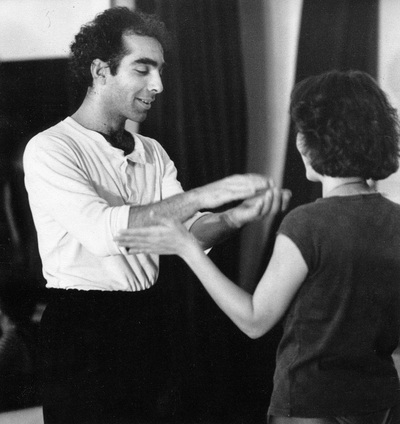
Angelus Iván a Kreatív Mozgás Stúdióban
Openly licensed images via Europeana; rights statements on each item page.
Notable figures

Goyo Montero
Spanish ballet dancer, ballet director and choreographer

Chris Elam
American choreographer

Cesare Negri
Italian ballet dancer

Maya Plisetskaya
Russian ballet dancer (1925-2015)

Margot Fonteyn
British ballerina

Jackie Chan
Hong Kong actor and martial artist (born 1954)

Vasili Vainonen
Russian choreographer (1901–1964)

Vyjayanthimala
Indian actress, dancer and parliamentarian
Movies featuring contemporary dance
- Hallelujah! (1929)
- Dance for Modern Times (1987)
Recent research
- Neurocognitive control in dance perception and performance. — Acta psychologica, 2012
- Dance exposure, wellbeing and injury in collegiate Irish and contemporary dancers: A prospective study. — Physical therapy in sport : official journal of the Association of Chartered Physiotherapists in Sports Medicine, 2018
- Ballet and Contemporary Dance Injuries When Transitioning to Full-Time Training or Professional Level Dance: A Systematic Review. — Journal of dance medicine & science : official publication of the International Association for Dance Medicine & Science, 2019
- Force Attenuation Properties of Padded Dance Support Socks. — Journal of dance medicine & science : official publication of the International Association for Dance Medicine & Science, 2022
- Early auditory processing in musicians and dancers during a contemporary dance piece. — Scientific reports, 2016
More contemporary dance research →
Books about contemporary dance
- Fifty contemporary choreographers by Martha Bremser, Lorna Sanders (2005)
- Modern educational dance by Rudolf von Laban (1948)
- Pina Bausch by Royd Climenhaga (2007)
- Routledge Dance Studies Reader by Jens Giersdorf, Yutian Wong (2010)
- The art of making dances by Doris Humphrey (1959)
- Transcending Boundaries by Donald McKayle (2001)
Encyclopedia summary
Contemporary dance is a genre of dance performance that developed during the mid-twentieth century and has since grown to become one of the dominant genres for formally trained dancers throughout the world, with particularly strong popularity in the U.S. and Europe. Although originally informed by and borrowing from classical, modern, and jazz styles, it has come to incorporate elements from many styles of dance. According to the New Grove Musical Dictionary, contemporary dance evolved from the foundations of modern and postmodern dance, emphasizing innovation and a break from traditional forms. Due to its technical similarities, it is often perceived to be closely related to modern dance, ballet, and other classical concert dance styles. It is characterized by a blend of styles that often integrate elements of ballet, modern dance, and cultural or social dance forms.
In terms of technique, contemporary dance tends to combine the strong but controlled legwork of ballet with modern dance that stresses on torso. It also employs contract-release, floor work, fall and recovery, and improvisation characteristics of modern dance. Unpredictable changes in rhythm, speed, and direction are often used as well. In the 1980s, the approach to contemporary dance became more intentional and academically focused, often described as “interdisciplinary” and “collaborative.” This period marked a shift from spontaneous and experimental methods to choreographies grounded in intellectual concepts, such as mathematical structures and repetitive patterns. Contemporary dance sometimes incorporates elements of non-western dance cultures, such as elements from African dance including bent knees, or movements from the Japanese contemporary dance, Butoh. Contemporary dance continues to explore natural movement while embracing diverse influences and unconventional staging.
Additionally, contemporary dance also examines the concepts of choreography and dramaturgy. The distinction between composition and improvisation, as well as between finished works and ongoing processes, is collapsed in the style of contemporary dance. This dissolution between previously rigid distinctions parallels broader cultural shifts from what scholar Gabrielle Klein calls the "linguistic turn," which treated dance as a form of text and choreography as a structured linguistic system, to the subsequent "performative turn" which critiques representational practices and introduces new themes central to contemporary choreography. These themes include liveness, immediacy, authenticity, identity, and the interplay between presence and absence. As a result, contemporary dance works have become platforms for exploring complex themes, such as the unrepresentable and intangible aspects of human existence, which are difficult to represent using traditional and classical movement forms.
Frequently asked questions
What is the difference between contemporary and modern dance?
Modern dance refers to the early-20th-century techniques of Graham, Humphrey, Limón, Horton and others. Contemporary dance is the later, more eclectic practice that mixes those techniques with ballet, release work and improvisation.
What is the difference between contemporary and lyrical?
Lyrical stays close to the song's lyrics and the ballet–jazz vocabulary. Contemporary is more abstract and uses more floor work, weight shifts and unusual shapes.
What BPM is Contemporary Dance?
Contemporary Dance is usually danced to music between 60 and 120 beats per minute. Browse 880 songs that fit on our Contemporary Dance music page.
How many calories does contemporary dance burn?
About 279 calories per hour for a 155-lb (70 kg) person, based on a MET value of 3.8 from the Compendium of Physical Activities. See calories burned contemporary dance for every body weight.
Related styles
Modern Dance
United States and Germany, early 20th century
Ballet & Theatrical DanceLyrical Dance
United States competition studios
Ballet & Theatrical DanceBallet
Italian Renaissance courts; codified in 17th-century France
Ballet & Theatrical DanceJazz Dance
African American vernacular dance; theatrical jazz on Broadway and in film
Ballet & Theatrical DanceTap Dance
United States — African rhythmic traditions meet Irish and Scottish step dancing
Ballet & Theatrical DanceMusical Theatre Dance
Broadway and London's West End
Last reviewed October 2026 · Editorial policy